
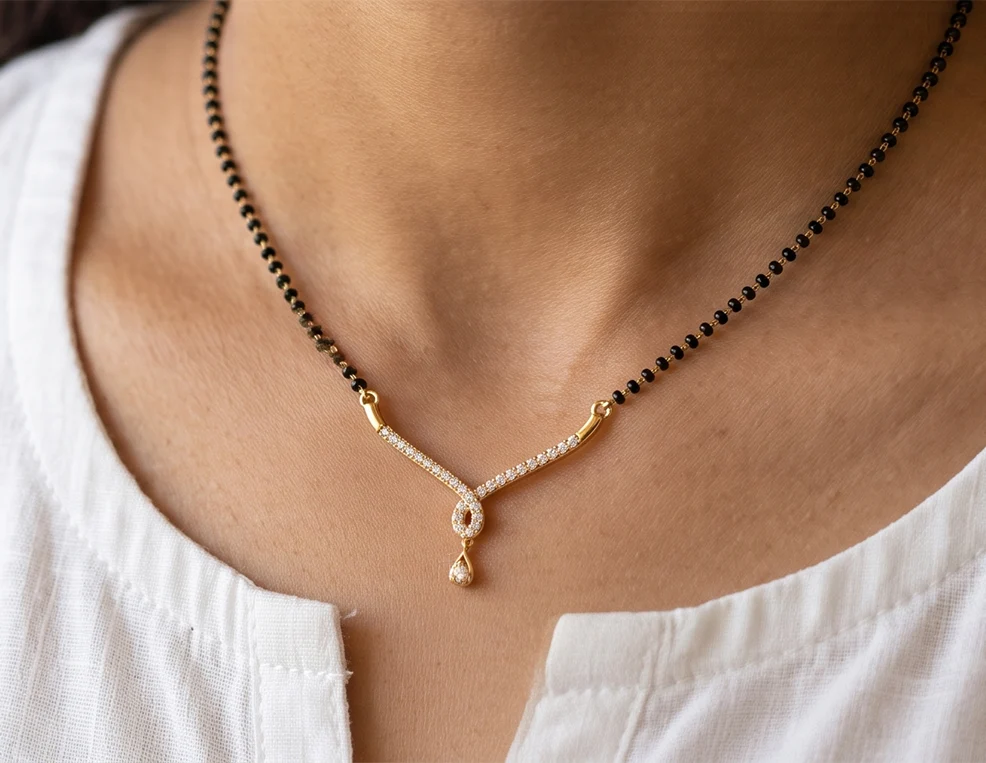
The mangalsutra is perhaps the most consistently worn piece of jewellery in a married Indian woman’s wardrobe. Unlike the elaborate necklace sets or chandbali earrings that come out for weddings and festivals, the mangalsutra is there every day, with every outfit, in every setting. This makes the choice of design far more consequential than it might initially appear. A mangalsutra that works well for a reception but sits awkwardly under a formal shirt collar, or one that is beautiful but too heavy for a twelve-hour working day, is not really serving its purpose.
The challenge for today’s bride is balancing two things that can pull in opposite directions: the cultural significance of the mangalsutra, which calls for a design that honours tradition, and the practical reality of wearing it daily, which calls for something comfortable, discreet when needed, and versatile enough to suit a modern wardrobe. The good news is that contemporary jewellery design has made enormous strides in resolving this tension.
Understanding the Mangalsutra Across Regional Traditions
The mangalsutra is not a uniform design across India. Each region has its own form, and each form carries its own cultural weight. The Maharashtrian mangalsutra is among the most distinctive, featuring black beads on a gold chain with a vati pendant. The vati, a small cup-shaped or disc pendant, is specific to Maharashtrian tradition and is considered the defining element of the design.
The South Indian thali is a different form entirely, typically a single pendant on a gold chain, without the black bead elements prominent in Maharashtrian and North Indian designs. Bengali designs favour a shakha and pola bangle combination over a pendant necklace. For brides from multicultural backgrounds or intercultural marriages, understanding which tradition to honour, or how to blend elements, is a meaningful part of the jewellery selection process.
Length: The Most Practical Decision
The length of the mangalsutra chain determines how it sits with different necklines and how visible it is in everyday wear. Traditional long mangalsutras, typically 24 to 30 inches, sit well below the neckline and are ideal for traditional outfits and ceremonial occasions. For daily wear with western clothing or formal Indian workwear, a shorter 18-inch chain sits at the collarbone and tucks neatly under a shirt collar when needed.
Many brides opt for two mangalsutras, one longer traditional piece for ceremonies and a shorter, lighter version for daily wear. This approach gives full flexibility without requiring compromise on either register. Some jewellers also offer extender chains that allow a single piece to be worn at different lengths depending on the occasion.
Pendant Design: Traditional Forms and Contemporary Interpretations
The pendant is where most of the design variation in mangalsutras occurs. Traditional vati pendants in plain gold remain the most culturally significant for Maharashtrian brides. Contemporary interpretations retain the vati form but add diamond accents, floral motifs, or geometric detailing that gives the piece additional visual interest without departing from its cultural roots.
Diamond-set mangalsutra pendants have become popular in urban markets because they transition well across contexts. A diamond centre in a gold vati reads as traditional in a family setting and as fine jewellery in a professional or social one. For brides navigating both worlds, this dual readability is practically useful.
The range of mangalsutra designs available from established jewellers spans this entire spectrum, from plain gold vatis in classic forms to contemporary diamond-studded pendants on slim chains.
The Tanmani Connection
In Maharashtrian jewellery tradition, the tanmani occupies a related but distinct space. A tanmani is a type of pendant necklace, typically worn at engagements and significant family celebrations, that features a layered or beaded structure with a central pendant. It is considered part of the essential Maharashtrian jewellery repertoire alongside the mangalsutra.
For brides planning their complete jewellery trousseau, the tanmani is worth considering alongside the mangalsutra rather than instead of it. The two pieces serve different occasions and have different visual characters, but they share a cultural vocabulary that makes them natural companions. Exploring the tanmani pendant collection alongside your mangalsutra selection gives a fuller picture of the Maharashtrian bridal jewellery tradition.
Black Beads: Significance and Care
The black beads in a Maharashtrian mangalsutra are traditionally made from a combination of gold beads and black glass or stone beads. The black beads are believed to offer protection against negative energy, and their presence is considered essential to the mangalsutra’s ritual significance.
From a care perspective, the black beads require gentle handling. They should not be soaked in chemical cleaning solutions, and the threading should be inspected periodically and replaced before it becomes too worn. Most jewellers offer a restringing service and can also replace damaged beads. Having the mangalsutra serviced every few years ensures that it remains secure and that the threading does not fail unexpectedly.
A Piece That Grows With You
The mangalsutra is unique among bridal jewellery in that it is intended to be worn indefinitely rather than reserved for occasions. This longevity means the initial choice of design matters enormously. A design that feels right at twenty-five may still need to work at fifty. Classic forms with thoughtful contemporary touches are almost always a better investment than highly fashion-forward designs.
For brides who want personalised guidance on navigating the full range of options, from traditional Maharashtrian designs to modern interpretations, the experienced team at Waman Hari Pethe Sons brings deep knowledge of both the cultural and practical dimensions of mangalsutra selection. It is a purchase worth taking time over, and having the right advice makes that time well spent.

 LOOK 01
 LOOK 02
 LOOK 03